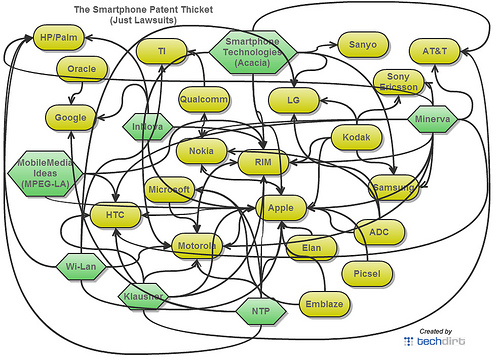
Techdirt prefers the following view of mobile patent lawsuits over one prepared by Information is Beautiful a few weeks earlier. Take these graphics with a grain of salt; both versions, for example, show Nokia versus Qualcomm, but those two have settled (for now). In its version, Techdirt adds entities that aren’t vendors, such as patent holding firms (in the hexagons).
Other entities get pulled in, too. Show up at an industry standards-setting meeting in which a plaintiff or defendant is participating, and you might get a subpoena, just for good measure.
Patent pools are sometimes used for efficiency, including that gained from reduced litigation. Techdirt makes an argument against them saying they restrict innovation. It prefers to let the market decide, presumably by having patent holders negotiate with each other. It has a point, but that is what wireless companies did before patent pools, and the pools’ formation were themselves a market response to that hassle. I don’t think the IEEE 802.11 patent pool has hindered the remarkable innovation still ongoing in that family of technologies. To the extent it has, I think it would be offset by patent pool efficiencies, such as moving things along more quickly. If companies don’t like a pool, they can and do choose to not join and instead negotiate separately. Qualcomm and some other companies, for example, chose to sit out the patent pool for 3G W-CDMA, even though they held essential patents.