Could Wi-Fi networks be used for emergency alerts, like systems used by cellular, television, and radio? There’s some interest in doing so in IEEE Working Group 802.11.
Read the rest of this entry »Recently
Emergency alerts using Wi-Fi networks
January 22nd, 2020Ron Rackley
April 15th, 2019Reports yesterday brought sad news of the passing of consulting engineer Ron Rackley. If you’ve listened to AM, you’ve benefited from his work.
GSA reports on status of LTE in unlicensed and shared spectrum
January 17th, 2019LTE in unlicensed and shared spectrum remains at an “early stage” worldwide with interest “high,” according to a report published by the Global Mobile Suppliers Association (GSA). Technologies discussed in the report include LAA, eLAA (LAA with uplink support), LTE-U, LWA (LTE Wireless-LAN Aggregation), LWIP (LTE WAN Integration with IPSec tunnel), and US-oriented CBRS. These are described in the report.
IEEE 802.11 working on successor to 802.11ax
July 16th, 2018Last Friday the IEEE 802 Executive Committee approved Working Group 802.11’s request to form an Extreme High Throughput (EHT) Study Group. This means there’s sufficient interest to work toward launching a more-formal EHT standard-development project, which will likely happen after the Study Group’s work is complete.
Using wireless to restore communications after a disaster
January 29th, 2018Since the 2011 Tōhoku earthquake and tsunami in Japan, NTT has stepped up research on new wireless systems to aid in disaster recovery. Some of its progress is shared in several articles in the January 2018 issue of the NTT Technical Review.
GSA looks 5G spectrum worldwide
January 11th, 2018The Global Mobile Suppliers Association (GSA) has provided a snapshot of 5G spectrum activity around the world as of the end of December 2017. “Activity” can include plans, trials, and regulatory consideration. The bands range from 600 MHz to 86 GHz. There’s some inaccuracy as GSA depends on incomplete information from some regulators, operators, and vendors, but it’s the best collection of public domain information.
FCC moves to improve Wireless Emergency Alerts
January 10th, 2018At its January 30 meeting, the FCC will likely vote to approve an item that would lead to improvements in Wireless Emergency Alerts, primarily by requiring that alerts be delivered with more geographic precision — as close as is practical to a target area specified an alert originator. This is intended, in part, to reduce the potential for over-alerting and resultant subscriber opt-out of receiving alert messages. Among other things, the item would additionally require that WEA-capable mobile devices preserve alert messages for 24 hours after its received.
Concurrent multi-band Wi-Fi floated in IEEE 802.11
May 31st, 2017A proposal for concurrent multi-band Wi-Fi was brought into the most recent meeting of working group IEEE 802.11. Similar to how mobile broadband can use multiple bands at the same time, the proposal would allow a Wi-Fi connection to use the 2.4 and 5 GHz bands simultaneously. Data would be split based on instantaneous channel conditions.
Tracking LTE in unlicensed spectrum, and related technologies
April 20th, 2017The Global Mobile Supplier’s Association (GSA) has started tracking the use of unlicensed spectrum to improve LTE throughput. It recently issued its first in a series of quarterly reports. The report can be downloaded following a registration process.
NTT’s overview of 5G radio standardization
March 14th, 2017NTT DOCOMO researchers discuss 3GPP’s 5G radio standardization process in the March 2017 issue of NTT Technical Review.
It explains the phasing of 5G radio development. Phase 2 is the end of the current concentration of activity due for completion in late 2019. That specification is intended to meet ITU’s IMT-2020 performance requirements. Phase 1 is for early commercial deployment. Before Phase 1 is done a third mode (called non-standalone, which is explained) will be culled for even earlier commercial deployment. (They also refer to Phase 1 and Phase 2 as 5G and 5G+, respectively.)
IEEE 802.11 overview
March 11th, 2017For next week’s IEEE 802 meetings in Vancouver the 802.11 leadership has prepared a presentation (PowerPoint) giving an overview of the group and highlighting selected current activities:
- High Efficiency WLAN — 802.11ax
- Wake up Radio — 802.11ba (Saves power using a wake-up frame to transition to primary connectivity out of sleep.)
- Light Communications Interest Group
It’s a handy snapshot.
Future of the wireless world: The move to 5G
March 8th, 2017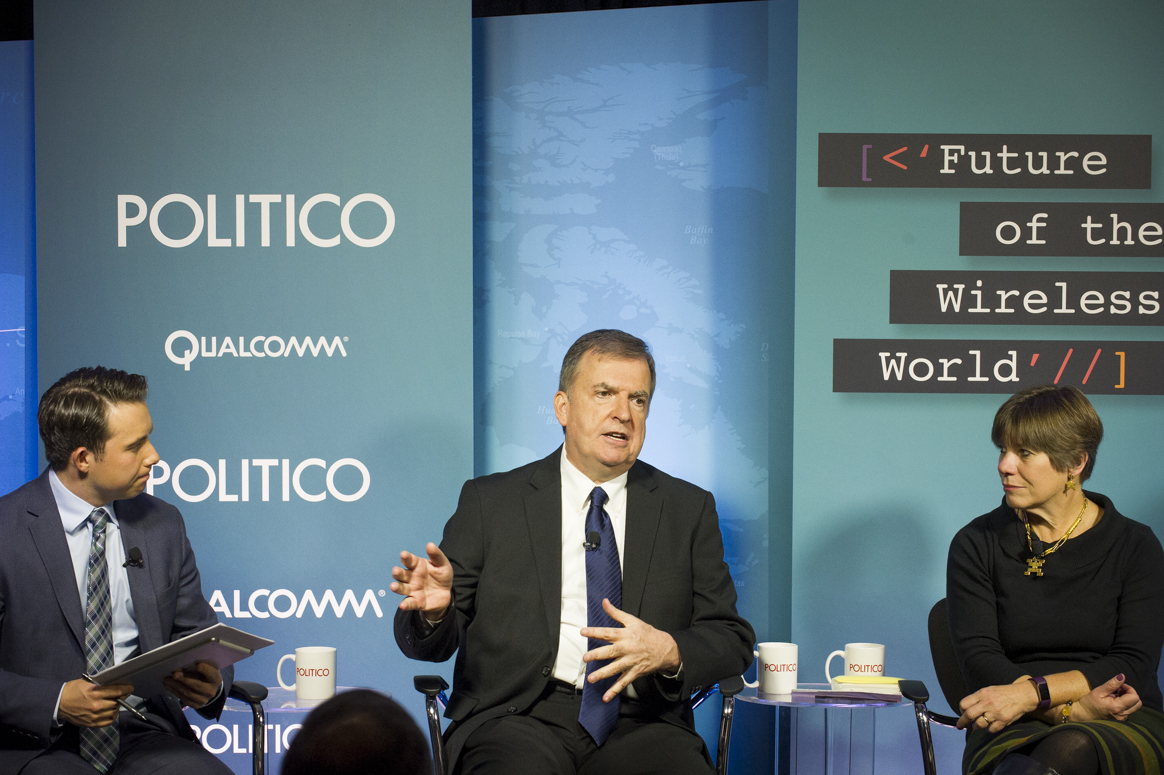
I was pleased to participate in this March 7 event presented by Politico and Qualcomm. The event page with video is here.
TIA surveys operators on 5G
February 22nd, 2017The Telecommunications Industry Association (TIA) has surveyed the 5G views of 31 mobile network operator executives from around the world. The findings were recently published (registration required). It’s implied that the survey used 5G in the most common sense — that of 3GPP, which has targeted completion of 5G specifications for 2020. (No one owns the term 5G — Verizon has its own 5G specifications, at least for now.)
Google updates engineers’ group on 3.5 GHz CBRS
February 15th, 2017A recent meeting of the Association of Federal Communications Consulting Engineers (AFCCE) hosted Dr. Andrew Clegg from Google. He updated the group on the status of the 3550-3700 MHz Citizens Broadcast Radio Service (CBRS). Google has been an active proponent, including through work in the Wireless Innovation Forum (WinnForum), which is developing spectrum-sharing standards.
Mobile vendors bump LTE Broadcast
February 1st, 2017The mobile vendor community reminds us that LTE Broadcast exists and could get traction any day now. In a January 30 update (registration required) The Global Mobile Suppliers Association (GSA) puts the best light on trials that haven’t quite transitioned to a business.