The Global Mobile Suppliers Association (GSA) has provided a snapshot of 5G spectrum activity around the world as of the end of December 2017. “Activity” can include plans, trials, and regulatory consideration. The bands range from 600 MHz to 86 GHz. There’s some inaccuracy as GSA depends on incomplete information from some regulators, operators, and vendors, but it’s the best collection of public domain information.
Archive for the ‘Spectrum’ Category
GSA looks 5G spectrum worldwide
Thursday, January 11th, 2018Future of the wireless world: The move to 5G
Wednesday, March 8th, 2017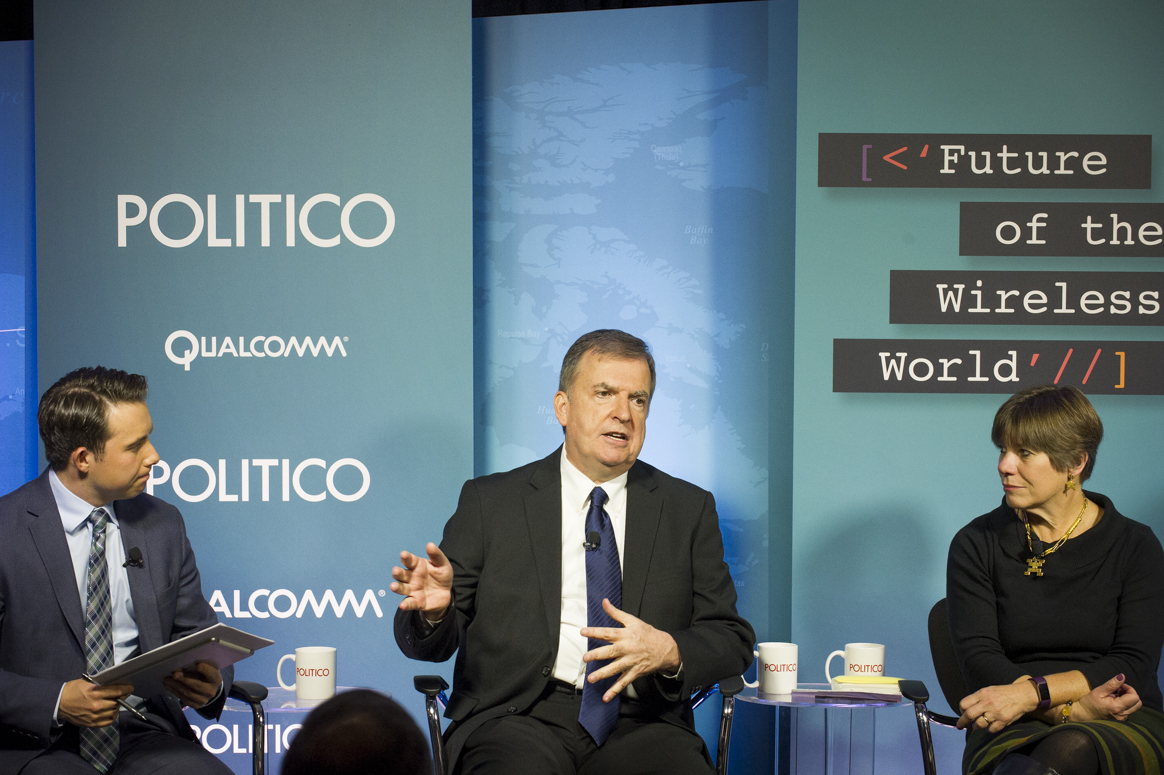
I was pleased to participate in this March 7 event presented by Politico and Qualcomm. The event page with video is here.
Experimental authorizations mined
Friday, January 27th, 2017TIA converges on the network of the future
Monday, June 9th, 2014Once a year the Telecommunications Industry Association (TIA) holds a membership meeting that looks forward to tomorrow’s networks. Last week I moderated a spectrum panel at the “Network of the Future” conference in Dallas, and stayed for the rest of the wireless track (parallel tracks I didn’t attend related to software-defined networking and big data).
Sinclair outlines converged broadcast/broadband vision
Wednesday, May 21st, 2014Sinclair Broadcast Group, the country’s largest TV group owner, is also a communications technology proponent. With partner Coherent Logix, a developer of software defined radio (SDR) technology, it’s behind one of several systems up for consideration in the Advanced Television Systems Committee (ATSC) for next-generation television in the U.S.. The new standard will be known as ATSC 3.0.
Dubious spectrum efficiency metric won’t die
Wednesday, May 29th, 2013In the FCC’s incentive spectrum auction proceeding, Information Age Economics (IAE) complains about the reliance of some in the industry (CTIA and Verizon, to name a couple) on a spectrum efficiency metric that simply divides an operator’s nationwide spectrum holdings by the number of subscribers. This results, in one example they give, of Sprint having 3.57 Hz per subscriber and Verizon having 1.05 Hz per subscriber. Some take this as Verizon using spectrum more efficiently, and perhaps being at a disadvantage. As IAE points out, however, spectrum is not partitioned to users this way: cellular infrastructure allows for frequency reuse. If one wants to compare the spectrum efficiency of Sprint and Verizon, don’t look at it nationwide — look at, say, Washington, D.C.
FCC’s 5 GHz spectrum initiative could mean more and wider channels for IEEE 802.11ac
Thursday, January 10th, 2013FCC Chairman Julius Genachowski yesterday announced an initiative to make 195 MHz of more spectrum available for Wi-Fi in the 5 GHz band.
The last time more spectrum for Wi-Fi was made available in this range was in 2003, when an FCC increased the then 300 MHz bandwidth to 555 MHz. As the document in that last link shows, the 5 GHz band is not as neat as the 2.4 GHz band, with other services, such as radar, requiring protection. These coexistence issues will have to be looked at again.
Deloitte’s mobile-broadband spectrum policy primer
Monday, October 15th, 2012Deloitte recently issued a new report on mobile broadband. It positions the U.S. as number-one and offers tips to keep it there, some more useful than others. There’s not much new for the mobile broadband expert. The collection of various mobile-spectrum policy issues into one document, however, could be useful to some, especially to those new to the field. Early on, Deloitte promises suggestions for improving U.S. spectrum policy; the suggestions, however, turn out to be mostly things we’ve heard before. There are a few problems with the report, discussed below, that readers should keep in mind.
4G Americas Scenario Shows Mobile Data Growth Tapering Off
Wednesday, May 16th, 20124G Americas, a wireless industry trade association representing the 3GPP family of technologies, has released a report looking at broadband devices and applications, and their impact on HSPA and LTE networks. There’s quite a bit of interesting information; here I highlight the discussion on mobile broadband offload and mobile data growth.
Experimental Radio Applications at the FCC
Sunday, February 5th, 2012This summarizes a selection from 215 applications for the Experimental Radio Service received by the FCC during October, November, and December 2011. These are related to AM broadcasting, FM broadcasting, spread spectrum on HF and VHF, unmanned aerial vehicle control, electronic warfare support, small satellites, white space technology, video production, managed access, TV interference, RFID, and radar. The descriptions are listed in order of the lowest frequency found in the application.
Three Invalid Assumptions that Make the FCC’s Spectrum Requirements Model Skew High
Saturday, November 19th, 2011“To generalize, it is often true that studies will be promoted that tend to support the policy inclinations of the Chairman, under whose direction, after all, every draft decision is made.”
“[S]tatistics can lie. But cast as ‘studies’ by commentors, they take on the weight that a decision maker chooses to make of them.”
As a follow-on to its National Broadband Plan, the FCC last year released a Technical Paper intended to validate the Plan’s prediction of a 300 MHz mobile-broadband spectrum deficit by 2014. The Paper describes a spectrum requirements model that totals current spectrum assigned to mobile broadband and applies a multiplier based on expected demand, taking into account expected increased tower density and improvements in air-interface spectrum efficiency. The model’s result is a predicted deficit of 275 MHz in 2014, which rounds to 300 MHz. On the way toward that result, however, the analysis uses just a few of the available data forecasts, ignores offloading of macrocell data to Wi-Fi and femtocells, and assumes the continuation of flat-rate plans for consumers. Some of these oddities I noted in a post at the time. I had hoped the FCC would make the Paper a subject of public comment. That hasn’t happened. So, I’ve looked at the Paper in more detail. I find that when looking at the above factors in a more realistic manner, predicted spectrum requirements go down significantly.
Experimental Radio Applications at the FCC
Sunday, November 6th, 2011This summarizes a selection from 173 applications for the Experimental Radio Service received by the FCC during August and September 2011. These are related to long-range low-frequency radar, amateur radio, shortwave data, wireless microphones, single-sideband, mine detection, millimeter-wave communications, signal intelligence, automotive radar, satellite feeder links, meteor-burst communications, aircraft telemetry, white space systems, border security radar, 3G and 4G applications, RFID, wind turbine testing, unmanned aerial vehicles, spacecraft telemetry and control, aircraft passenger broadband, and autonomous aircraft landing systems. The descriptions are sorted by the lowest frequency found in the application.
Filling the Spectrum Pipeline
Thursday, September 8th, 2011CTIA’s International Case for More Spectrum
Tuesday, August 30th, 2011In a recent blog post, CTIA compares some measures of the U.S. wireless industry to those in nine other countries. The purpose is two-fold; to show the U.S. is a leader in number of subscribers, lowest cost per voice minute, and spectrum efficiency, and to argue the need for getting more mobile broadband spectrum in the “pipeline.” These goals are somewhat at odds, and the spectrum-efficiency argument I don’t get, as I’ll explain, but within the constraints of a blog post I think CTIA makes the case that the U.S. is a clear leader in some areas, and that the prospects for more mobile spectrum in the U.S. are fuzzier than they should be today.
Spectrum, Data, Capacity, and PR
Thursday, May 19th, 2011A couple of days ago the Mobile Future coalition posted a short video on YouTube advocating the allocation of more spectrum for mobile broadband. As evidence of the need, it says that, compared to feature phones, smartphones use 24 times the spectrum and tablets 120 times the spectrum.